


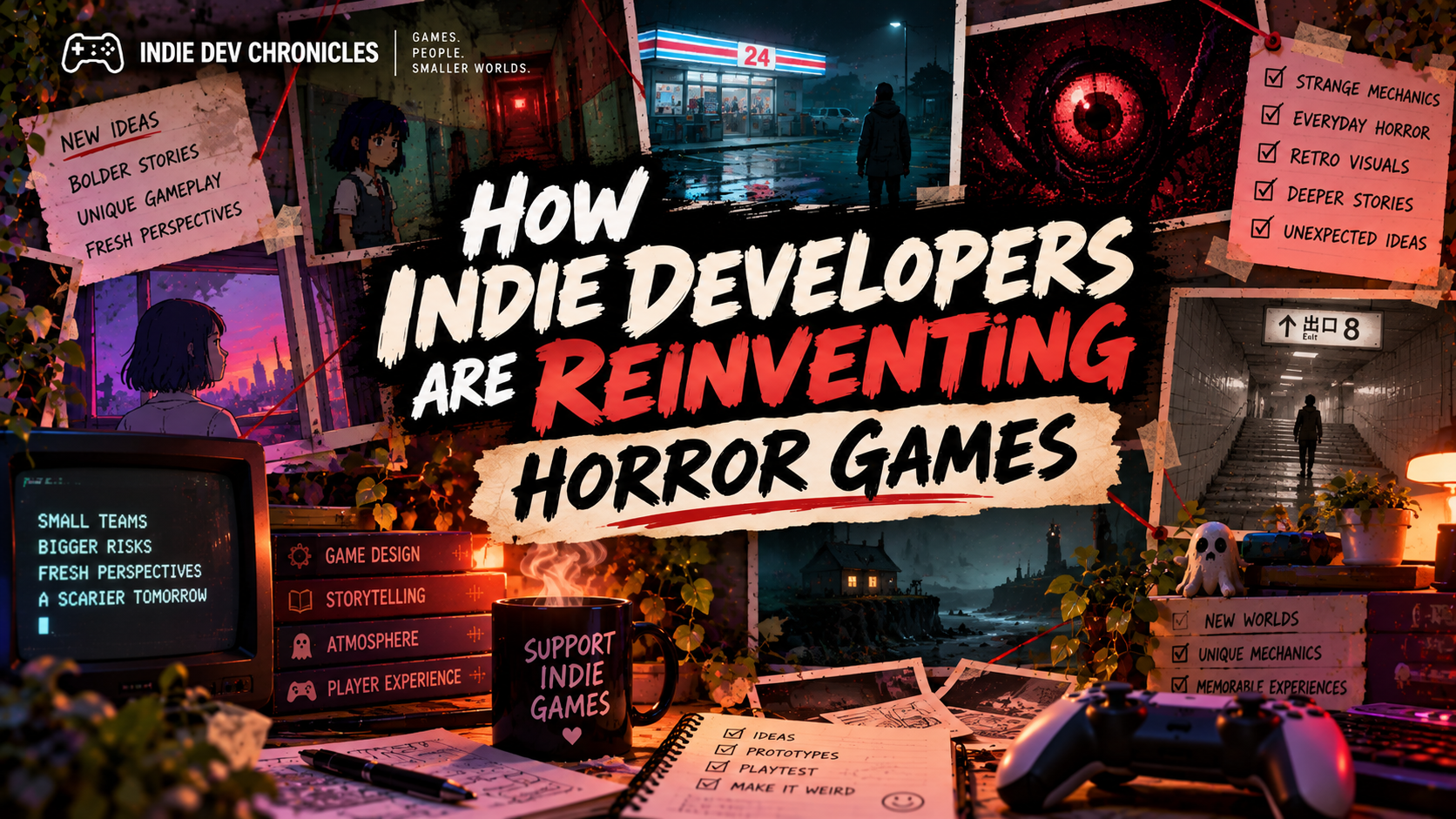
Horror games have come a long way from the days of running through dark hallways, searching for keys, and hoping you have enough ammunition to survive whatever is waiting around the corner. Don’t get me wrong. There’s still something special about classic survival horror. But lately, some of the most interesting ideas in the genre have been coming from smaller developers who aren’t afraid to do things differently. Instead of following the same formulas, they’re turning everyday activities into nightmares, experimenting with unusual gameplay mechanics, and finding ways to make players uncomfortable without relying on traditional scares. And the results have been fascinating. Indie horror games are showing us that horror doesn’t have to look, sound, or even play the way we expect.
Sometimes, all it takes is one strange idea to create something unforgettable.
Horror Doesn’t Always Need a Monster
When you think about horror games, you probably imagine something chasing you.
Maybe it’s a terrifying creature, a supernatural presence, or an enemy that seems impossible to defeat.
But what happens when there’s nothing obvious to run from?
That’s where some indie developers have started getting creative.
Take The Exit 8, for example.
The game places you inside a seemingly endless Japanese underground passageway. Your objective is to observe your surroundings, identify unusual changes, and figure out how to escape.
Sounds simple enough.
Until you start noticing things that weren’t there before.
A sign looks different. A person behaves strangely. Something about the hallway just doesn’t feel right.
Instead of fighting monsters, you’re fighting your own uncertainty.
And that’s what makes the experience so effective.
You start paying attention to every little detail because you never know what might be important.
It’s a different kind of fear, one built around observation rather than combat.
They’re Turning Ordinary Jobs Into Nightmares
There’s something especially unsettling about horror games that begin with completely normal situations.
You show up for work.
You follow instructions.
You complete your tasks.
Then things start getting weird.
Developers like Chilla’s Art have built memorable horror experiences around everyday activities.
In The Closing Shift, you’re working at a coffee shop. In The Convenience Store, you’re handling a late-night shift at a small shop.
Neither setting sounds particularly frightening at first.
But that’s exactly why they work.
These games take environments we recognize and slowly introduce situations that make us uncomfortable.
Suddenly, a customer standing outside too long feels suspicious.
An unfamiliar noise becomes something you can’t ignore.
And the thought of being alone at work starts feeling a lot less ordinary.
Indie horror games have become particularly good at turning familiar experiences into situations that make players question their surroundings.
You don’t need an abandoned mansion when an empty parking lot can be just as unsettling.
They’re Experimenting With How We Actually Play
One of the most exciting developments in indie horror is how developers are changing the way players interact with their games.
Instead of simply walking, hiding, or fighting, some games build their entire experience around unusual mechanics.
Who’s Lila? is a perfect example.
Rather than choosing dialogue responses in the traditional way, players manipulate the main character’s facial expressions to influence conversations.
It’s an unusual mechanic that fits the game’s disturbing atmosphere.
You’re not just deciding what a character says.
You’re controlling how they appear to feel.
And because the game revolves around uncomfortable interactions and strange mysteries, that mechanic becomes part of the horror itself.
Then there’s Iron Lung.
You’re trapped inside a tiny submarine, exploring a mysterious ocean with extremely limited visibility.
You can’t simply look through a window to see what’s around you.
Instead, you navigate using instruments and a camera that produces still images of the environment outside.
That limitation changes everything.
Every movement feels uncertain because you never have a complete picture of your surroundings.
These games demonstrate how a single gameplay mechanic can become the foundation for an entire horror experience.
Retro Graphics Are Becoming a Creative Choice
We’ve spent years watching video games become more realistic.
Characters look more lifelike. Environments become more detailed. Lighting gets closer to what we’d expect from a movie.
But indie developers have been embracing something completely different.
Old-school graphics.
And not just because they’re nostalgic.
Games like Murder House, Alisa, and Crow Country use retro-inspired visuals to create distinctive horror experiences.
Low-resolution textures, unusual character models, and classic camera perspectives can make environments feel strange in ways that realistic graphics sometimes don’t.
There’s also something interesting about not being able to see every detail clearly.
Your imagination starts filling in the gaps.
Was that a person standing in the corner?
Did something just move?
Or are you imagining things?
Retro aesthetics aren’t automatically scary, but when developers combine them with strong atmosphere and thoughtful game design, they can create a unique sense of unease.
For many indie horror games, visual limitations have become part of their identity rather than something to overcome.
Horror Stories Are Becoming More Personal
Not every horror game needs to revolve around saving the world or defeating an ancient evil.
Sometimes, smaller stories are more effective.
Indie developers have been exploring horror through personal experiences, uncomfortable relationships, grief, isolation, and other emotional themes.
Detention, for example, uses its supernatural setting to explore a story shaped by political repression and personal tragedy.
Devotion builds much of its horror around family relationships and the disturbing events unfolding inside a home.
These games don’t rely entirely on whether something jumps out at you.
Instead, they create tension through the stories they’re telling.
And that can make the experience feel more meaningful.
Because once you’re invested in the characters and their circumstances, the horror becomes more than just trying to survive.
You want to understand what happened.
You want answers.
And sometimes, discovering the truth is more unsettling than the supernatural elements themselves.
They’re Making Us Question What a Horror Game Should Be
Here’s where things get really interesting.
What actually makes a game a horror game?
Does it need enemies?
Does it need jump scares?
Does it need to be dark?
Some indie developers seem determined to challenge those expectations.
Doki Doki Literature Club! initially presents itself as a cheerful visual novel about spending time with members of a school literature club.
But the experience eventually takes a disturbing turn.
The contrast between its friendly presentation and its darker elements is central to its impact.
Then there’s Inscryption, which combines deck-building gameplay, puzzles, and unsettling storytelling.
It’s not a traditional survival horror game, yet its atmosphere and presentation create an experience that feels deeply uncomfortable.
Both games demonstrate that horror can work within genres that don’t usually seem frightening.
And that’s what makes this period of indie horror so interesting.
Developers aren’t simply creating new monsters.
They’re finding new ways to make players feel vulnerable, uncertain, and curious.
Smaller Games Can Take Bigger Creative Risks
One reason independent developers can experiment so freely is that many aren’t trying to create enormous blockbuster experiences.
Of course, smaller studios face their own challenges, including limited budgets, development time, and difficulty getting noticed.
But a smaller project can sometimes be built around an idea that would be difficult to justify in a much larger production.
Maybe the entire game takes place in one room.
Maybe it lasts only an hour.
Maybe the central mechanic is something players have never encountered before.
That doesn’t automatically make the game successful.
But it does create opportunities for unusual experiences.
And when one of those ideas works, it can inspire other developers to experiment.
We’ve seen how short-form horror, retro-inspired visuals, and unconventional gameplay have become recognizable parts of the indie horror scene.
Not every experiment will work for everyone.
But the willingness to try something different keeps the genre interesting.
The Future of Indie Horror Looks Anything but Predictable
The exciting thing about indie horror games is that we don’t really know what developers will come up with next.
Someone could be working on a terrifying game about answering emails.
Or organizing a storage room.
Or following instructions that slowly stop making sense.
And somehow, any of those ideas could turn into an unforgettable horror experience.
That’s the beauty of the genre.
Fear isn’t limited to monsters, haunted houses, or jump scares.
It can come from uncertainty, unfamiliar mechanics, emotional storytelling, or the simple feeling that something isn’t quite right.
Indie developers are continuing to explore those possibilities, and players are getting experiences that feel increasingly different from traditional horror games.
If you want to explore some of the games pushing the genre in interesting directions, check out our 7 Underrated Indie Horror Games Worth Playing This Halloween article.
And if you’re curious about why these smaller experiences can be so effective, read Why Indie Horror Games Are So Good at Scaring Us.
With Halloween just around the corner, there’s no better time to see what indie developers have been creating.
What indie horror game do you think changed the genre? Is there a game with an unusual mechanic or story that completely surprised you?
Let us know in the comments!
