


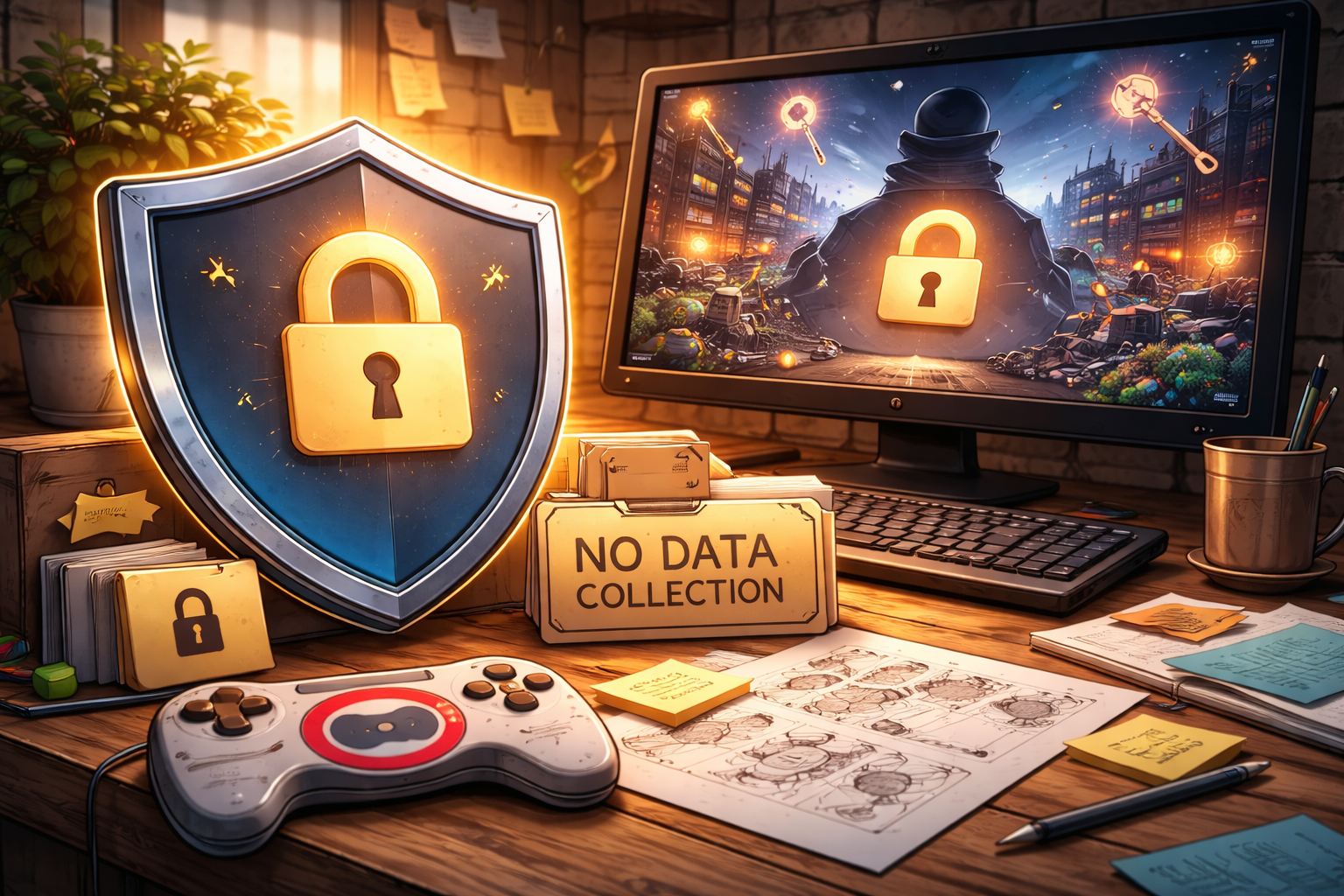
The Rise of Zero-Data Spy Games: Why Privacy Is Indie Gaming’s Newest USP
Data is everywhere in modern games.
Across platforms, accounts track behavior. Meanwhile, telemetry records movement. In addition, analytics monitor playtime. Because of this visibility, players are starting to notice.
As awareness grows, expectations are changing.
For that reason, a quiet trend is emerging. Indie developers are building zero-data spy games. These titles collect nothing. Instead, they track nothing and watch nothing.
As a result, privacy is becoming one of indie gaming’s strongest new selling points.
Why Players Are Finally Paying Attention to Data
For years, data collection stayed invisible.
Back then, logins felt normal. Similarly, tracking went unquestioned. Privacy policies were ignored. However, trust has begun to erode.
Recently, players have started asking harder questions:
- Why does this game need an account?
- What data is being collected?
- Where does that data go?
- Who benefits from it?
Because those questions are now common, expectations have shifted.
What “Zero-Data” Really Means in Games
Zero-data does not mean disconnected.
Instead, it means intentional restraint.
In practice, these games:
- Require no accounts
- Avoid background analytics
- Skip invasive telemetry
- Store progress locally
As a result, players control their experience without being observed.
That difference feels immediate.
Why Indie Developers Are Leading the Shift
Large studios depend on data.
Publishers need metrics. Meanwhile, investors expect insights. Marketing teams demand funnels. Consequently, privacy often becomes negotiable.
Indie studios operate differently.
Because teams are smaller, incentives change. Fewer stakeholders mean fewer tracking requirements. More importantly, creative control increases.
That freedom allows indies to ask a different question:
What happens if we simply collect nothing?
Privacy as a Feature Instead of a Limitation
At first glance, zero-data design sounds restrictive.
In practice, it becomes empowering.
Without analytics:
- Games feel more personal
- Players feel less observed
- Design choices feel deliberate
As a result, trust becomes part of the experience.
That trust is increasingly rare.
Why “Spy Games” Have Become the Counterculture
The term “spy games” is not about espionage mechanics.
Rather, it reflects surveillance.
Many mainstream games quietly monitor players. Every action becomes a metric. Over time, that awareness creates friction.
Zero-data indie games choose the opposite path.
Instead, they communicate something clear:
- Play freely
- Explore without judgment
- Fail without being measured
Because of that philosophy, these games feel different immediately.
How Zero-Data Design Changes Game Development
Removing data collection affects design choices.
For example, difficulty tuning relies on playtesting rather than dashboards. Likewise, balance decisions come from observation instead of heatmaps. Meanwhile, player behavior is respected instead of optimized.
As a result, development feels more human.
That difference shows in the final product.
Why Privacy Resonates With Indie Audiences
Indie players often value intention.
They appreciate craft. Additionally, they respect boundaries. Because of that mindset, they support creators who share their values.
Since privacy aligns with independence, zero-data design feels authentic. Rather than extracting value, these games offer space.
That exchange builds loyalty.
The Unexpected Marketing Advantage
Ironically, privacy sells.
When a game clearly states:
- No accounts required
- No tracking
- No data collection
Players notice.
In a crowded market, that message stands out. Moreover, it spreads organically. As a result, trust becomes a talking point.
That is marketing without surveillance.
Why This Trend Is Accelerating in 2026
Several forces are converging.
First, privacy awareness is rising. Second, regulation discussions are expanding. Third, players are increasingly tired of being treated as products.
Because of these shifts, indie developers are well positioned. They can move quickly. They can communicate clearly. Most importantly, they can choose restraint.
That combination creates opportunity.
The Real Value of Zero-Data Games
This movement is not about nostalgia.
Instead, it is about consent.
When players know nothing is watching, engagement changes. Curiosity replaces caution. Immersion deepens.
Ultimately, emotional safety becomes part of the design.
Final Thoughts
Zero-data spy games are not anti-technology.
Rather, they are pro-player.
By prioritizing privacy, indie developers are redefining value. They are proving that trust can be a feature. They are also showing that restraint can be innovative.
In a data-driven industry, that choice feels radical.
And in 2026, it may be indie gaming’s most compelling USP.
