


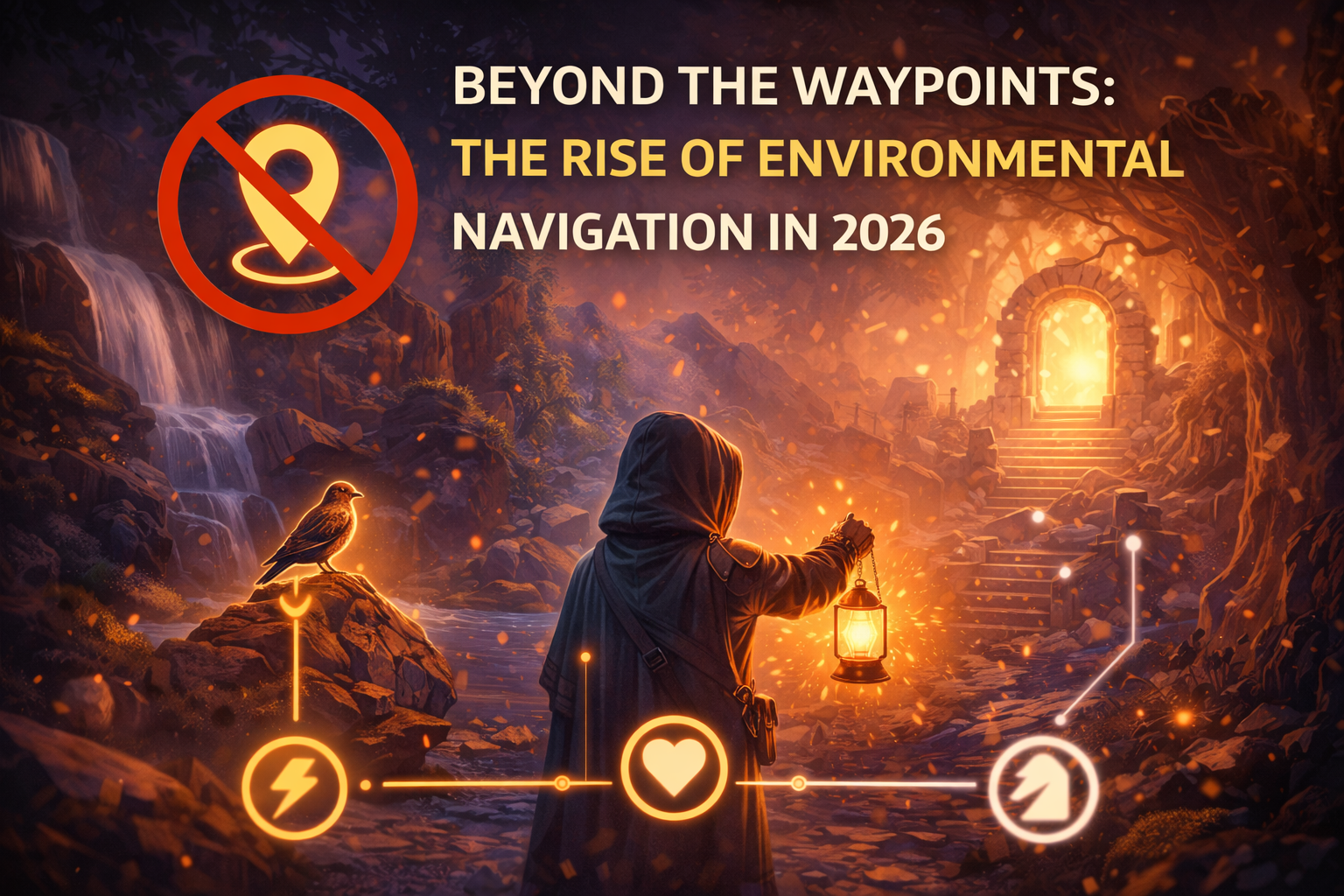
A design critique of the Metroidbrainia trend where games like Mio: Memories in Orbit ditch maps for discovery-based gameplay
For most of gaming history, maps have been central.
They guided players. They reduced uncertainty. They told you where to go next. However, something is shifting in 2026.
Instead of pointing players with icons and waypoints, a growing number of games are trusting the world itself to guide players. This idea, often called environmental navigation, puts discovery and intuition over markers and arrows.
In some circles, this trend has earned the name Metroidbrainia — an evolution of Metroid-style exploration where your understanding of space becomes the primary navigation tool.
Rather than provide maps, games like Mio: Memories in Orbit invite players to read the world, feel its rhythms, and discover paths organically.
This article explores why this trend is rising now, what it changes about level design, and why players are responding positively.
What Environmental Navigation Actually Is
Environmental navigation does not remove goals.
Instead, it hides them more deeply.
Rather than showing icons or maps, the game world itself conveys information through:
- terrain cues
- structural landmarks
- sound and light gradients
- enemy and resource placement
Because waypoints are absent, players must interpret the environment to find direction.
This design treats players as explorers rather than travelers following GPS.
From Waypoints to World Cues
Traditional waypoints serve a purpose: clarity.
However, they also do something else. They reduce curiosity.
Put an arrow on the screen, and most players will follow it without question. As a result, exploration becomes a checkbox rather than a choice.
By contrast, in Metroidbrainia design:
- players must remember past locations
- they must recognize visual motifs
- choices carry spatial memory
- the world feels like a puzzle
In games like Mio: Memories in Orbit, this approach creates a sense of place instead of a series of destinations.
Because direction is hidden in the world itself, progression feels earned rather than handed out.
Why This Trend Is Growing in 2026
Several forces converge to push environmental navigation into the spotlight.
First, players increasingly want immersion over instruction. Waypoints and minimaps can pull players out of a game’s atmosphere. By minimizing UI guidance, games keep players rooted in the world.
Second, indie developers are experimenting more boldly with space as narrative. Rather than rely on dialogue or menus, designers are using terrain as a storytelling device.
Third, accessibility tools have matured. Instead of forcing all players to guess blindly, many games use subtle environmental cues and design language to support navigation without explicit markers.
Because of these trends, players are more open to this design gamble than they were several years ago.
How Mio: Memories in Orbit Shows the Potential
In Mio: Memories in Orbit, direction is not given — it is discovered.
There is no traditional minimap. There are no arrows telling you which way to go next. Instead, players learn through:
- star patterns
- shifts in lighting and color
- sound motifs that guide movement
- contextual environmental storytelling
For example, a distant melody may draw you toward an objective. Meanwhile, the absence of noise may signal danger.
By embedding cues in the world itself, the game makes navigation part of the experience instead of a separate mechanic.
Because of that integration, discovery feels personal rather than procedural.
Why Players Are Responding Well
Some players crave guidance. Others resist it. Still, many are finding environmental navigation refreshing.
This is partly because:
- curiosity becomes a reward, not a requirement
- every route feels meaningful
- players build spatial memory naturally
- worlds feel more like ecosystems than levels
Additionally, social sharing helps. Players post routes they discovered, highlight environmental techniques, and discuss how they read cues. That community interaction reinforces the joy of discovery.
When players work together (informally), the absence of waypoints becomes a feature, not a barrier.
Design Challenges and Criticisms
This trend is not without its pitfalls.
Some players feel lost. Others want clearer signals. Because environmental cues can be subtle, accessibility is a concern. Therefore, developers must balance minimal UI with supportive design.
As a result, many teams include optional tools:
- dynamic hints triggered by player behavior
- context-aware audio prompts
- visual gradients that feel natural rather than intrusive
In other words, environmental navigation needs design literacy and player empathy to succeed.
What This Means for Future Exploration Games
Environmental navigation is more than a gimmick.
It represents a shift in how designers trust players.
Instead of guiding players by the nose, this trend assumes players can interpret space, remember landmarks, and build a cognitive map.
Because that assumption shapes gameplay and narrative, worlds feel denser. They feel alive.
When direction comes from environmental storytelling instead of UI markers, exploration becomes more than movement — it becomes meaning.
Final Thoughts
The age of waypoints was never wrong. It clarified direction and reduced frustration.
However, in 2026, a growing number of designers are asking a different question: What happens when the world itself teaches you where to go?
Environmental navigation answers that.
Metroidbrainia elevates it.
Games like Mio: Memories in Orbit prove it works.
Beyond the Waypoints is not a rejection of clarity. Instead, it is a reinvention of how clarity emerges — not from icons and arrows, but from listening to the world and finding your own way.
